
How the brain listens – and to what
Have you heard of the cocktail party effect? When you are in a crowded space, you can direct your hearing and choose who in the room to listen to. Oskar Keding, doctoral student in mathematical statistics, has investigated how selective auditory attention can be measured and applied, for example in developing hearing aids.
Susanna Lönnqvist – Publicerad den 31 maj 2026
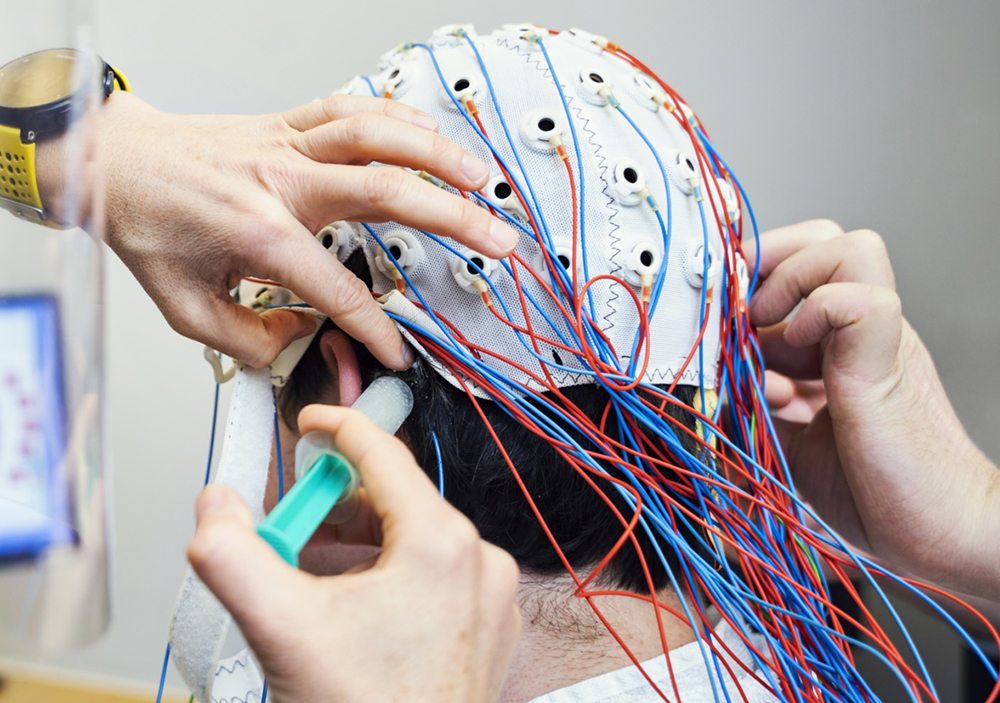
In his thesis, Oskar Keding has developed methods for processing and handling data obtained from electroencephalographic (EEG) measurements. EEG measures brain activity using electrodes attached to the scalp. Signals from the brain are often disrupted for example by the skull, and the data has to be cleaned and made usable.
Although the ears are specialized organs, it is not the ears themselves that perform hearing. Rather, it is the signal processing that takes place at different locations and levels within the central nervous system that enables us to hear. Opponent Professor Edmund C. Lalor from Rochester University emphasized in his opening introduction how complex the process of hearing really is, and how increased knowledge about selective attention could contribute to the development of better hearing aids with more effective noise reduction and a kind of “built-in” cocktail party ability. Hearing impairment and difficulties in adapting assistive devices can lead to increased social isolation and subsequent negative health effects.
Oskar Keding has investigated automation of the processing of EEG data. His studies further develop methods for investigating selective attention in different scenarios, where participants were asked to direct and shift their attention between different speech targets. They show that mathematical models can describe relationships between speech signals and recorded signals from the brain. Patterns of attention at a certain frequency was also shown to reveal how attention changes over time, and this dynamic is interesting for how hearing aids could be further improved. One goal is for such devices to perform the signal processing required for cocktail party hearing in real time.
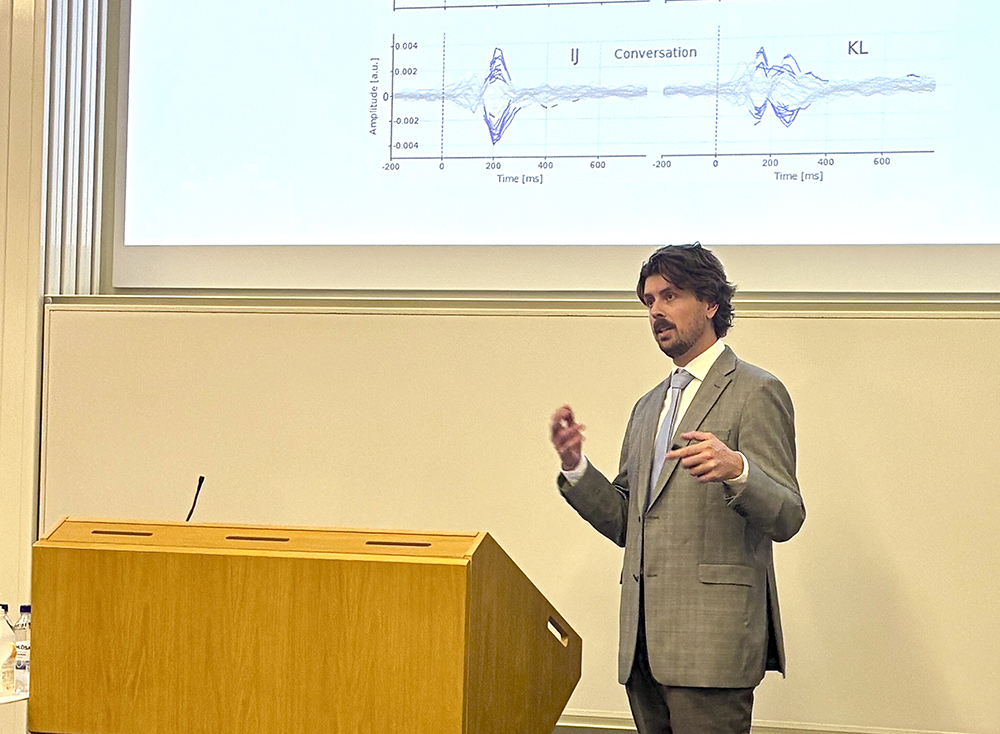
Oskar Keding
Oskar Keding, doctoral student in Mathematical Statistics – in Lund Universitety Research Portal
Thesis: Selective Attention Tracking
Oskar Keding defended his thesis, “Selective Attention Tracking: Neural Markers in Listeners Across Hearing Conditions,” on May 27, 2026.
Oskar Keding’s thesis in the Lund University research portal