
Robot learning from all angles
Research on robot learning spans from interpretation of sensing data to a robot executing actions in the real world, disciplines the organizers of the ELLIIT focus period on robot learning now bring together in Lund from beginning of November.
Susanna Lönnqvist – Publicerad den 22 October 2025
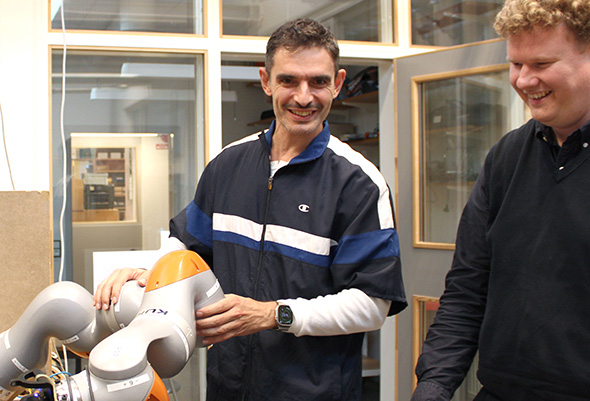
ELLIIT (Excellence Center Linköping–Lund in Information Technology) is a strategic research area based at Linköping University and LTH. Twice a year, ELLIIT organizes so-called focus periods, during which researchers within a specific theme are invited for extended guest stays. Each focus period includes a three-day symposium that brings together the invited researchers and internationally renowned speakers in the field. In November, the focus period on robot learning will begin in Lund, hosted by the Department of Automatic Control.
Robotics is inherently a multidisciplinary field, and robot learning draws insight from subjects such as machine learning, robotics, control theory, and neuroscience. As robots are increasingly being deployed in human environments, from the vacuum cleaner in your home to the interactive rescue robot, the focus on training and learning of the robots increases. Training a large language model has certain boundaries: by providing the model with training data, it can for example learn to produce sensible text. In contrast, robot learning involves physical actions of a robot in an open and unpredictable environment:
“Robots act in the physical world, which is difficult to model due to uncertainty. As expectations on safety, interaction, and collaboration increase, it is crucial that robots learn from their surroundings to advance the field,” says Yiannis Karayiannidis, Associate Professor at the Department of Automatic Control, Lund University.
“Historically, robots have been programmed to perform one task, for example for a pick-and-place task in a factory, with little or no workspace sensing involved. Today, more collaborative robots need to interact with, understand, and learn from their surroundings,” says Björn Olofsson, Associate Professor at the Department of Automatic Control, Lund University.
Having one robot per task is costly, and reprogramming a robot for a new task is costly both in money and time, where runtime is lost, and expertise that you might not have in-house is needed. A robot that learns from interactions, failure, and successful execution, enables deployment of general-purpose robots in a broad variety of contexts.
“Reinforcement learning is when robots learn to make optimal decisions by combining exploration and exploitation. The exploration involves trial-and-error learning through interaction with its surroundings. In exploitation, the robot uses the knowledge it has gained from real-world interactions to make actions through feedback,” says Björn Olofsson.
How to learn
One of the research challenges in robot learning is the efficacy of the different learning modalities:
“Exploration, again, is costly both in time it takes for the robot to learn this way, and in money since testing things in the real-world setting will cost you hardware and equipment,“ says Yiannis Karayiannidis.
This is where simulation as a method comes in, where simulated robots can explore simulated environments. Moving from simulation to real is one of the topics that is being explored during the focus period symposium, where organizers hope to create opportunity for in-depth discussions.
“Each of the three symposium days will end with a panel including the day’s speakers, and we invite and encourage everyone attending to take part in the discussions and bring forward their unique perspectives,” says Björn Olofsson.
Throughout the focus period, the RobotLab infrastructure at LTH will be made available to ELLIIT and guest researchers to inspire new ideas and deepen collaborations that may lead to future joint research.
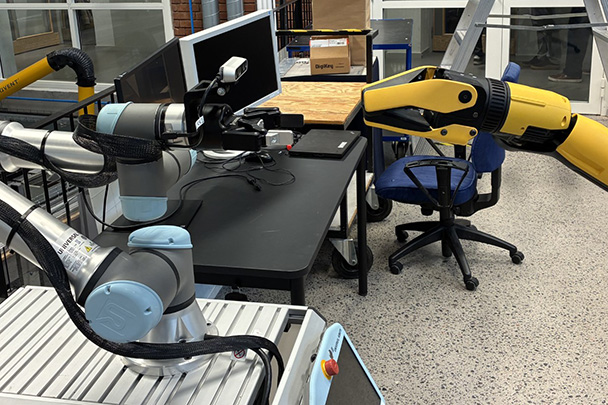
The Robot Lab is open
The Robot Lab will be open to guest researchers during the focus period on robot learning.
FACTS
- ELLIIT (Excellence Center at Linköping – Lund in Information Technology) is a strategic research area IT and mobile communication – a government funded initiative aimed at creating excellent Swedish research started in 2010
- The ELLIIT focus period on robot learning takes place November 3-December 5, 2025 with a three day symposium 18-20 of November
- Partner universities in ELLIIT are Linköping University, Lund University, Halmstad University and Blekinge Institute of Technology
- Lund University is involved in 11 of the 20 national strategic research areas
- First ELLIIT research focus periods were organized in 2022