
Three researchers awarded ERC Starting Grants
Lund University has matched its previous record, with six researchers awarded the prestigious ERC Starting Grant. Three are researchers from the Faculty of Engineering: Axel Henningsson, Kim Cuong Le, and Susanna de Rezende.
Jonas Andersson – Published 3 September 2026
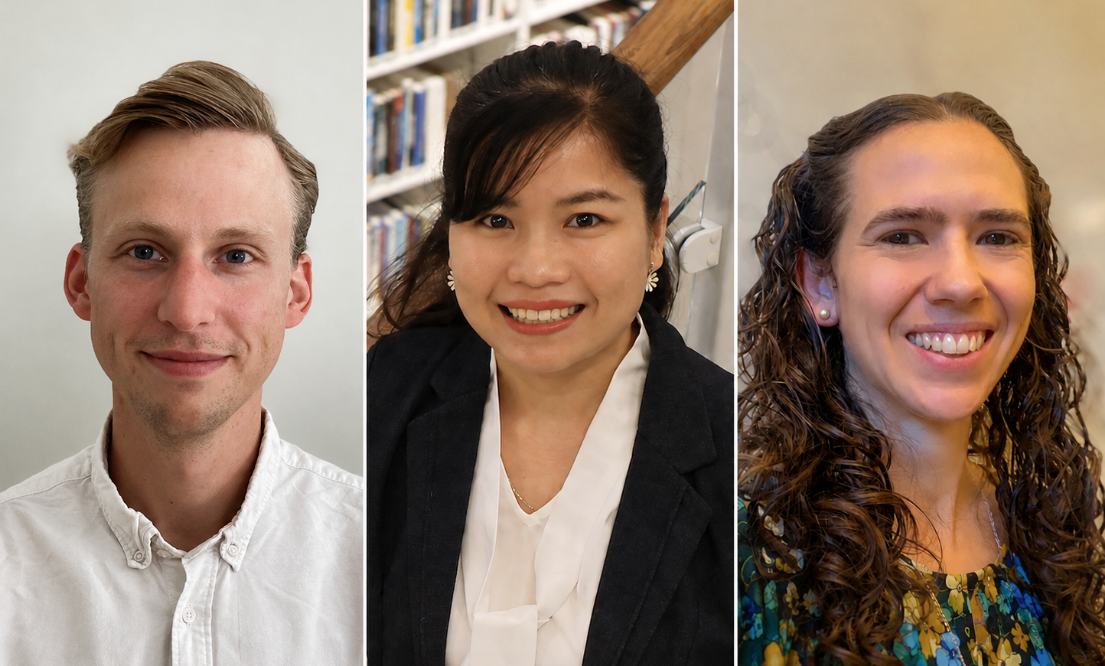
Axel Henningsson, currently postdoc at DTU
What is your project about?
The project aims to understand how ductile rupture originates and develops inside metals. Using high-energy X-rays at large-scale synchrotron facilities, we will develop new methods that can follow the material’s internal microstructure in three dimensions while it is being loaded. The aim is to create time-resolved 3D images, almost like movies, that simultaneously show how the crystal grains deform, how stresses and strains develop, and how microscopic voids form and grow until rupture.
What do you hope to achieve?
This project will make it possible to directly observe the mechanisms that govern how metals deform and fail. Current models are based partly on assumptions that are difficult to verify experimentally. By measuring the internal fields and microstructural changes that the models actually describe, we aim to test these assumptions and develop more reliable models of material failure. In the longer term, this could contribute to safer and more material-efficient structures. The experimental methods developed within the project will also benefit other areas of materials research.
What does this ERC grant mean to you?
For me, the grant is both a major recognition and a fantastic opportunity to build an independent research environment at Lund University. It gives me the resources and long-term stability needed to bring together a research group around an ambitious idea that would have been difficult to pursue within a smaller project. I am, of course, very happy, but I also feel a great sense of responsibility and a strong motivation to make the most of this opportunity.
Kim Cuong Le, senior lecturer at Combustion Physics
Can you tell us a little about your project?
Soot aerosols are produced by incomplete combustion of carbon-based fuels. They contribute to atmospheric warming and can also have adverse health effects. However, characterizing soot is particularly challenging in the aerosol phase because of its small size, low concentration, and continuous transformation in the atmosphere.
My AEROSOL project aims to advance laser- and X-ray-based diagnostics to track soot from its initial formation to its atmospheric aging. Ultimately, I want to establish how changes in soot structure and morphology affect its optical properties and therefore its climate impact.
What do you hope to achieve?
I hope to achieve two major advances. First, I want to push soot measurements to currently inaccessible regimes, including sub-10 nm particles, single-particle diagnostics, and real-time remote measurements. Second, I want to establish an experimentally constrained link from soot formation and aging, through its structure and optical properties, to its climate impact.
The long-term outcome will be both new diagnostic capabilities and a more comprehensive understanding of soot across laboratory, chamber, and atmospheric scales.
What does the ERC Starting Grant mean to you?
The ERC Starting Grant would allow me to take the next major step in establishing my independent research direction. It would give me the resources to build a multidisciplinary team around my core expertise in optical diagnostics and combustion, and to expand my research from soot formation in the laboratory to atmospheric aging and climate-relevant applications.
More importantly, it would allow me to pursue a high-risk, interdisciplinary research vision that would be difficult to realize through smaller individual grants.
Susanna de Rezende, associate senior lecturer, Department of Computer Science
Can you tell us a little about the project?
One of the big questions in computer science is to understand how hard different problems are for computers to solve. Some problems can be solved very quickly, while for others we do not know any efficient algorithm. Computational complexity theory tries to understand this difference: what are the possibilities and what are the limits of computation?
But there is a second, deeper question. Sometimes we believe that a problem is hard, because nobody has found an efficient algorithm. But we also cannot prove that no efficient algorithm exists. My project asks why this happens. Why is it so difficult not only to solve certain problems, but also to prove that they are hard?
What do you hope to achieve?
This project takes a step back and looks at the methods we use to prove that problems are hard. I want to understand the power and the limitations of these methods. When do they work? When do they fail? And can we explain why?
There has been a lot of progress on these kinds of questions in the study of computational models called circuits. My project brings this meta-level perspective to the field of proof complexity, which studies the length and structure of mathematical proofs. In simple terms, I want to understand the limits not only of computation, but also of our ability to reason about computation.
What kind of problems can it be about?
There is a wide range of problems that can be modelled mathematically. For example, scheduling flights, planning routes, allocating resources, or organising snow removal can all involve many variables and many constraints. We may want to find the most efficient solution, but as the number of variables and constraints grows, this problem can become extremely difficult.
My project is not about solving one specific scheduling or routing problem. Instead, it studies the mathematical foundations behind why some computational problems are hard, and why it can be so difficult to prove that hardness rigorously.
Some current technologies are based on the assumption that certain problems are difficult for computers to solve efficiently, including encryption systems used in e-commerce and online banking.
For some of these problems, we do not know any fast algorithm, but we also cannot prove that no fast algorithm exists. Still, modern cryptography often relies on the assumption that these problems are hard. If someone discovered a much faster algorithm, it could have major consequences for the security systems we use today.
What does an ERC Starting Grant mean to you?
It’s a game changer. It gives me the freedom to pursue an ambitious, long-term, high-risk, high-gain project, and to build a dedicated team of PhD students and postdoctoral researchers working exclusively on this project. I’m very grateful for the opportunity!