New heights with new frequencies
In much the same way as a lamp switches on above you as you walk under it in a corridor, a network can be created exactly where you are standing by using a new combination of frequencies for wireless communication. Researchers at LTH are investigating the conditions for future 6G applications using dual frequencies.
Susanna Lönnqvist – Published 14 September 2026
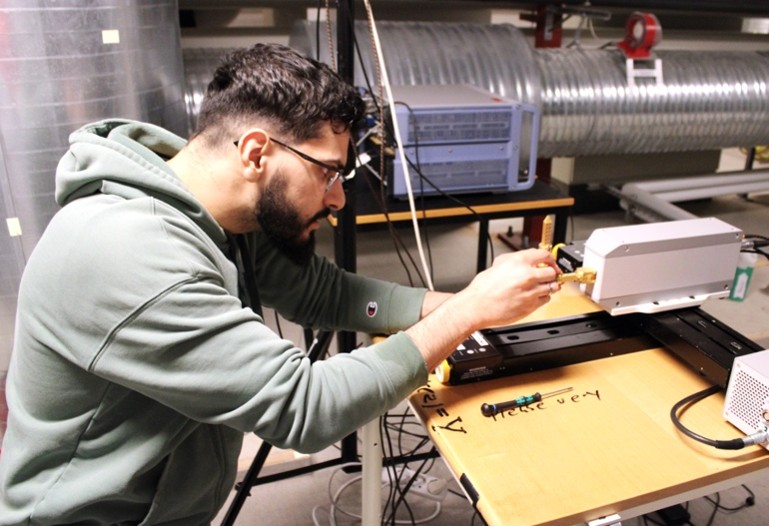
Today’s wireless networks are made up from base stations that transmit radio waves and receiving antennas. 5G, in turn, is based on a technology called MIMO. MIMO stands for multiple input–multiple output and means that a large number of antennas are used to simultaneously transmit signals. How efficient the network system is depends on everything from system design and synchronization of antennas and signals, to the actual physical environment through which the radio signal must travel.
“The radio channel itself – the space through which the radio waves are transmitted – has a strong impact on the signal and its strength. In a vacuum the situation would be easier, since the signal would travel unhindered in one direct path to the receiver. In reality the signals bounce off ceilings, walls, and objects. This leads the forming of several pathways for the signal to propagate, a so called multipath” says Ali Al-Ameri, a doctoral student at the Department of Electrical and Information Technology at LTH.
Network efficiency a key factor
For future technologies such as self-driving cars and an automated industry, network efficiency is a factor that must be taken into account. Even “ordinary” users are becoming more numerous, sending increasingly data-intensive messages, and living closer together in cities. Quite simply, the airspace where radio waves are transmitted is becoming crowded.
“Radio signals are transmitted at different frequencies, and in the 6G Tandem project we are now investigating the use of the 140 GHz frequency band together with MIMO technology,” says Ali Al-Ameri.
The 140 GHz frequency is not used today because it is a high frequency band, which means short electromagnetic waves and a signal that is easily blocked and is not reflect well. The project investigates a combination of frequency bands: the high-frequency band at 140 GHz and a more stable low-frequency band, where MIMO technology is already available. The novelty lies in placing the transmitter for the high frequency in the ceiling. This creates a radio channel that runs vertically, from above and downward, a radio channel that has not previously been described for the frequency under study.
“In our work, we have examined how the vertical channel behaves in different types of environments in order to combine a vertical high-frequency system with MIMO technology. The more stable low-frequency system can locate the user in the room, while the ceiling-mounted transmitter can provide the network exactly where it is needed and transmit from above,” Ali Al-Ameri explains.
The channel studied in various environments
Researchers at LTH have studied the radio channel in three different environments: an office, an environment with many metal surfaces, and in a standardized electronics laboratory set up. Measurements in the metal-rich environment were carried out to mimic conditions in an industrial facility or factory, and they show that radio waves reflect more and in different ways from metal surfaces compared to surfaces in an office environment.
“These experiments give us important information for describing the radio channel at 140 GHz and for the system design of a dual-frequency system,” says Ali Al-Ameri.
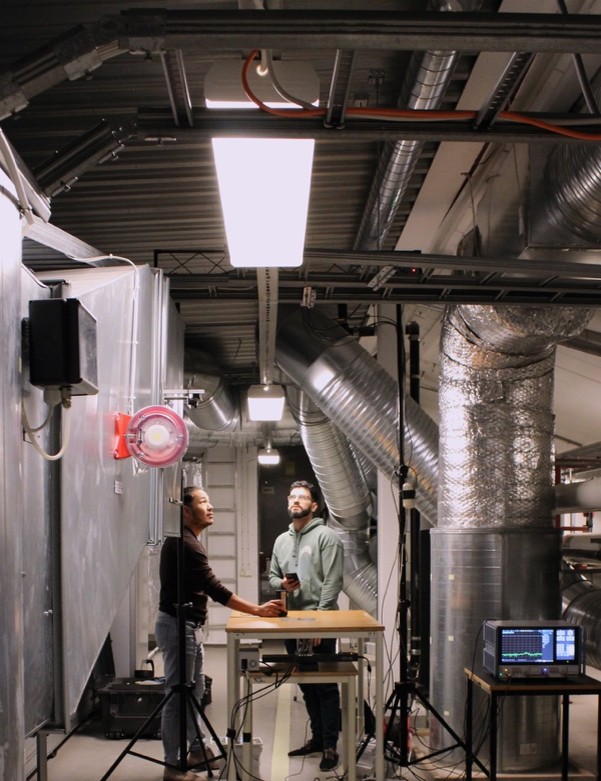
Aleksei Fedorov, research engineer, and Ali Al-Ameri, have carried out radio channel measurements in the attic of the E-building at LTH. Photo: Susanna Lönnqvist.
Ali Al-Ameri
Ali Al-Ameri is a PhD Student in Communications Technology at LTH.
The 6G Tandem Project
An EU-funded Horizon Europe project that investigates how dual frequencies can be used to create stable wireless networks for 6G applications.
Dual-frequency networks have the potential to support future applications that require extremely high reliability and network performance.
The project consortium consists of nine international partners, with LTH being one of four participating academic institutions.