Understanding a Warming World: Insights from Crafoord Laureate Veerabhadran Ramanathan
When Crafoord Prize laureate Veerabhadran Ramanathan visited Lund on 18 May, he combined personal reflections with a powerful scientific message: understanding aerosols and greenhouse gases is key to tackling climate chang, but solving the crisis will require new approaches, broad collaboration, and urgent public engagement.
Therese Ek – Published 26 May 2026
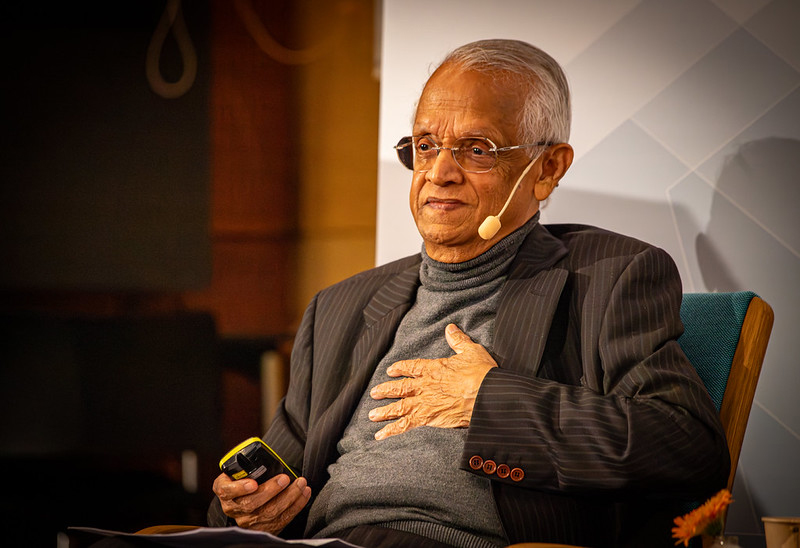
On Monday, May 18, Veerabhadran Ramanathan, Distinguished Professor (Emeritus) of Atmospheric and Climate Sciences, visited Lund to deliver the 2026 Crafoord Prize Lecture in Geosciences. He received the prize for laying the foundation for our understanding of how small particles and gases that accumulate in the atmosphere contribute to climate change—knowledge that is of great importance in combating global warming.
During the lecture, Veerabhadran Ramanathan, told the audience how his heart and soul are with the poor. His own personal journey began in 1944 in a village in South India, where he grew up as a shirtless child on a veranda. In 1974, his climate journey began at NASA, which took him to many places, not least to the Vatican and the Pontifical Academy of Sciences in 2004.
"I discovered there that science, and religion can work together to address the climate crisis. Faith leaders have access to people in a way that scientists do not,” said Veerabhadran Ramanathan.
The Climate Crisis Requires Multiple Disciplines and New Approaches
Veerabhadran Ramanathan says that even though fossil fuel emissions have benefited us all, they are outdated and need to be phased out. As a climate scientist, he sees his predictions on climate change come true, yet emissions and global warming continue to rise. He believes that the climate equivalent of the ozone hole over Antarctica, or a COVID moment, is rapidly approaching. A moment when climate change is no longer something happening somewhere else to someone else, but something that becomes noticeable to all of us and moves into our living room:
"We have the solutions, the brainpower, and the technology to solve this. But we need a new approach, and getting the public involved is going to be critical", says Veerabhadran Ramanathan.
Working with climate mitigation alone won’t be enough. We also need to adapt societies to changes already here and soon to become more intense and more frequent. To be successful, collaboration across all types of boundaries is crucial:
"Emissions anywhere are emissions everywhere. We are interconnected. We are never going to solve this by saying that others will fix it—we must work on this problem together. In terms of solutions, social scientists and economists must be involved. Increasingly, responsibility also lies in the hands of policymakers and cities, requiring transdisciplinary partnerships", says Veerabhadran Ramanathan.
Aerosols and Uncertainty: The Key to Understanding Accelerating Warming
Rather than talking about a greenhouse effect when discussing global warming, Veerabhadran Ramanathan says we should think of it in terms of a “blanket effect.” The greenhouse effect analogy can be somewhat misleading since a greenhouse becomes warm mainly because the air inside heats up and is trapped, unable to circulate or escape.
The atmosphere does not work this way, instead air is constantly moving. Rather, he argues greenhouse gases act like a blanket around the Earth. This blanket allows the sun’s energy to enter but retains some of the heat radiation that would otherwise escape into space. As we emit more greenhouse gases, this blanket becomes thicker, making it increasingly difficult for heat to escape and causing the planet to warm further.
At the same time as we have created a thicker blanket of greenhouse gases, humans have also released other air polluting aerosols into the atmosphere. These aerosols have acted somewhat like mirrors atop the blanket, suggesting that air pollution has been masking some of the global warming. But as the harmful effects of air pollution on human health have become clear, countries have also implemented many successful measures to reduce these emissions thus thinning the mask.
"The warming is accelerating, and my conclusion is that we are thinning the mask of air pollutants without thinning the blanket of greenhouse gases. This acceleration will likely continue, but there is significant uncertainty. Over the next 10–15 years, aerosols may be the most important issue in climate change, and we need the aerosol scientists to tell us what will happen next", says Veerabhadran Ramanathan.
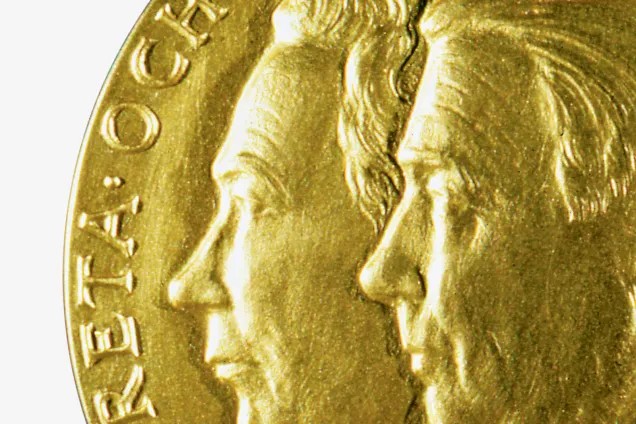
The Craaford Prize
The Crafoord Prize is awarded in partnership between the Royal Swedish Academy of Sciences and the Crafoord Foundation in Lund, Sweden. The Academy is responsible for selecting the Crafoord Prize Laureates.
The purpose of the Fund is to promote basic scientific research worldwide in the following disciplines:
- Mathematics and Astronomy
- Polyarthritis (systemic diseases that cause inflammation in the joints)
- Geosciences
- Biosciences (with particular emphasis on ecology)
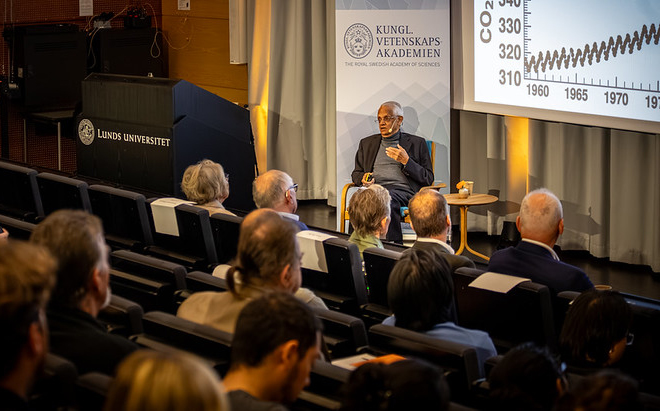
Watch the lecture with Veerabhadran Ramanathan
The Crafoord Prize Lecture in Geosciences 2026 given by Veerabhadran Ramanathan on YouTube.