
When the storm hit, will the dike hold?
A nature-based dike is designed to protect people and buildings from extreme storm surges. But how do soil and vegetation affect its resilience? Researchers at Lund University are investigating this on the Falsterbo Peninsula, using a wave impact generator to simulate wave load on the dike. Their findings will help build knowledge about how coastal communities can be protected as sea levels rise.
Jessika Sellergren – Published 3 November 2026
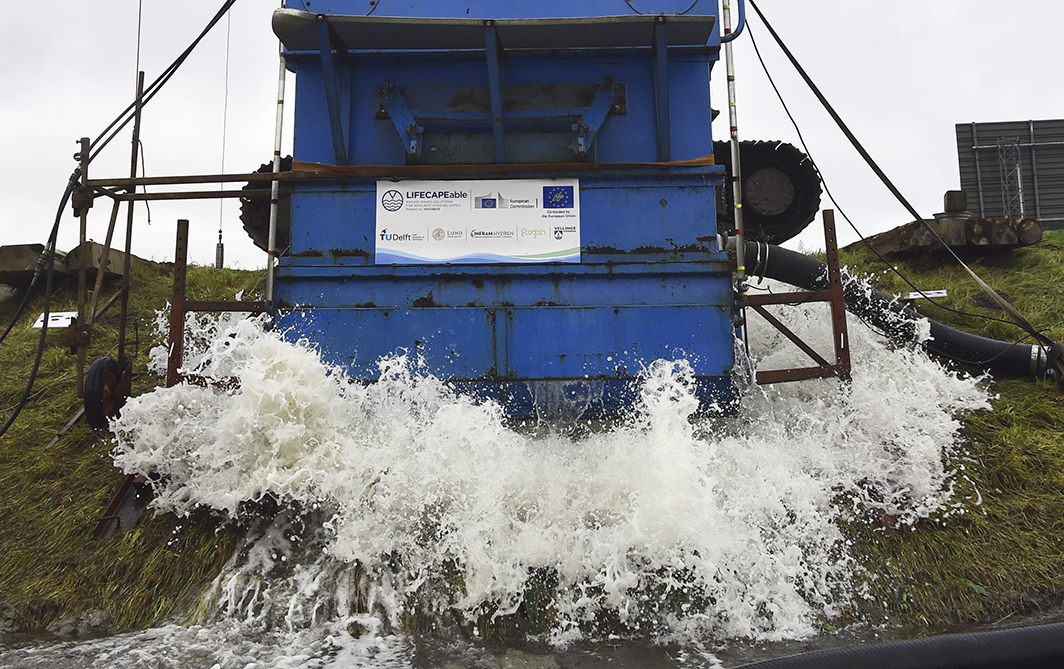
The need for effective coastal protection is growing as flooding becomes more frequent. At the same time, more knowledge is needed on how soil and vegetation affect the resilience of nature-based protective dikes. The EU project LIFECAPEable aims to provide this knowledge. The project involves collaboration between LTH, Lund University, Delft University of Technology, Vellinge Municipality and the environmental consultancy Ecogain.
Caroline Hallin is an Associate Professor of water resources engineering at LTH, Lund University, and the project leader for the research. She says:
“Close to the protective dike that has been built around the Falsterbo headland – which is the largest in Sweden with 14 kilometres of nature-based protection – we have constructed a test dike to investigate how soil and plants affect its protective function. The test dike is 50 metres long and 2 metres high, and has been planted with various vegetation in preparation for the wave tests.”
Simulated waves test the dike’s resilience
Using a wave simulator that colleagues from Delft University of Technology have transported here from the Netherlands, the researchers are sending waves towards the test dike to investigate how it is affected.
“The waves are crashing against the dike just as the waves from the sea would have done during a proper storm,” says Caroline Hallin.
The results of the field study are not yet available, but the researchers already suspect that different plant species and types of soil offer varying degrees of protection.
“The differences have been quite significant in our tests. Some parts of the dike’s protective layer have withstood around 700 waves, whilst other parts have only been able to withstand a couple of hundred,” says Björn Almström, a researcher in water resources engineering. However, he emphasises that further analyses are needed to investigate other factors that may affect the dike’s durability.
Vegetation and soil are put to test
Three different types of vegetation have been planted on the test dike: grass, comprising both fast- and slow-growing seeds; beach meadow plants, which are rich in species diversity; and vegetation from the surrounding area, which has taken root on the embankment after cut hay from nearby meadows was placed there.
The vegetation has been planted in two different types of soil: soil from the site where the dike was constructed, and soil with a low nutrient content.
“We want to investigate how different combinations of vegetation and soil act as protection. We also want to study whether the vegetation can both make the embankment more robust and contribute to biodiversity,” says Caroline Hallin.
After the waves, the holes are scanned
The wave generator pumps out waves towards the test zones on the dike. Each zone is struck by repeated series of 20 waves, with variations in wave height and angle of impact. After each series, surveys are carried out using a 3D scanner to document how the waves have affected the dike, whether the vegetation at the test point has been worn away, and how much soil has been eroded.
“The waves are directed towards the dike until the plants and their roots have been washed away and the underlying layer of clay is exposed. We then measure how many waves were needed for this to happen, and how long it took,” says Björn Almström.

The wave simulator is operated from a control room set up in a caravan at the test site. At the controls are Gerben van der Meer and Raylton Bendô from Delft University of Technology. Photo: Jessika Sellergren
During the tests, the researchers were surprised to find tunnels dug into the dike.
“We hadn’t really reckoned on moles and voles perforating the dike with their tunnels,” says Björn Almström.
He explains that the animals’ activities affect the resilience of the dike, which is important to bear in mind when planning the maintenance of the actual protective dike.
“It’s not enough to build a dike that works when it’s new. We also need to understand how it should be maintained and managed to ensure it remains functional over time,“ he says.
From a test dike to effective coastal protection
Running parallel to the test dike is Falsterbonäsets’ own, already established protective dike. It consists of soil and vegetation from the surrounding area and is a nature-based flood defence designed both to protect against high water flows and to provide other environmental benefits.
“This is how we hope to protect vulnerable coastal areas in the future,” says Carolin Hallin, adding:
“But it is not enough for the dike to be aesthetically pleasing and to promote biodiversity. It must also be able to withstand powerful storm surges. Thanks to our research, we will soon know more about which nature-based solutions offer the best protection and can bring real benefits to coastal communities.“
The EU project LIFECAPEable
The LIFECAPEable research project is investigating how nature-based solutions can protect low-lying areas from flooding whilst also contributing to biodiversity and other positive effects for both people and society. The project is funded by the EU LIFE Programme for a period of five years, until June 2028.
Participants:
- Lund University and LTH: Carolin Hallin, Coastal Engineer and Associate Professor in water resources engineering, Björn Almström, Coastal Engineer and researcher in water resources engineering och Pål Axel Olsson, Professor i plant biology
- Delft University of Technology: Alessandro Antonini, Associate Professor, Raylton Bendô, PhD Student and Gerben van der Meer
- Ecogain
- Vellinge Munucipality
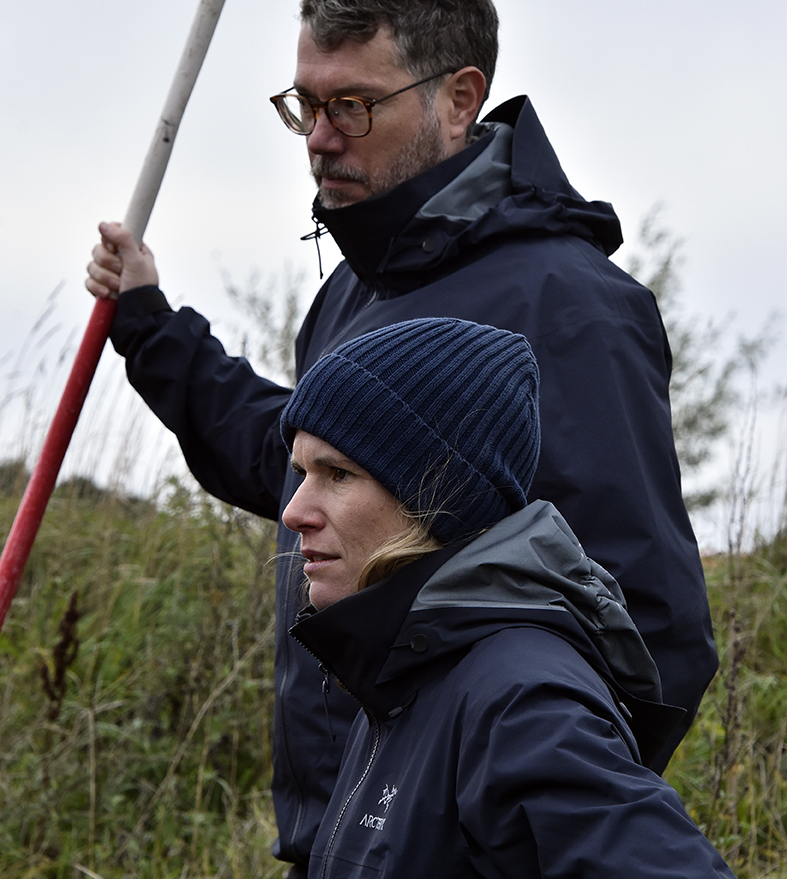
Caroline Hallin and Björn Almström
Caroline Hallin and Björn Almström are research colleagues in the field of water resources engineering at LTH and are both involved in the EU project on nature-based protective barriers for coastal communities.
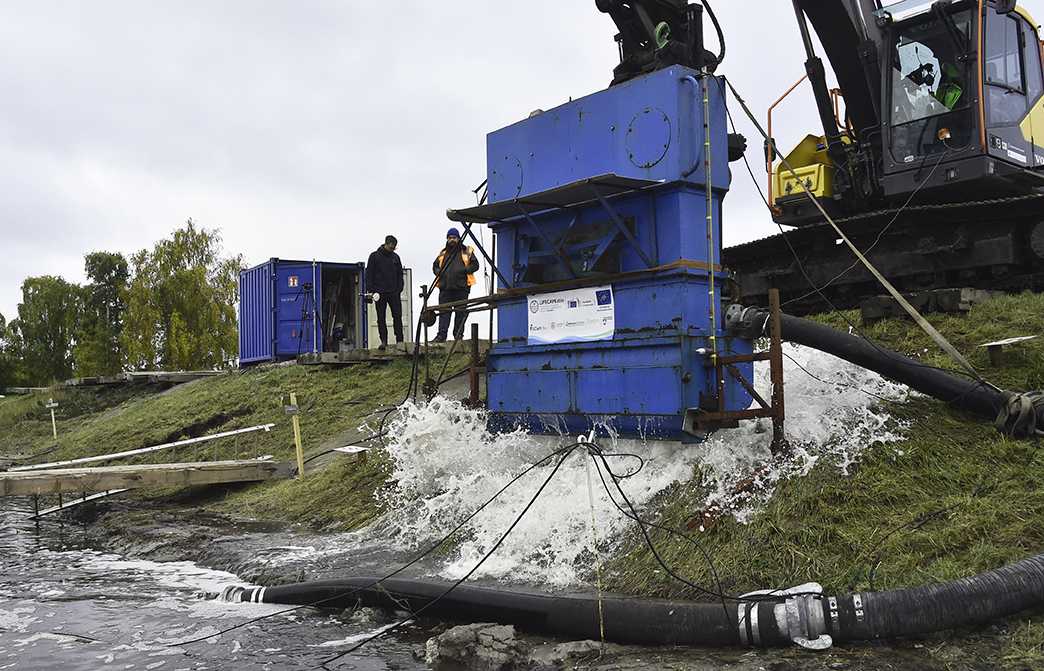
Film: How storm surges affect the protective dike
This is how the test dike is constructed
The researchers’ test dike, 50 metres long and three metres high, has a core consisting of soil. On top of the soil is a 30-centimetre-thick layer of clay that prevents water from penetrating the dike. At the very top is a 30-centimetre layer of topsoil, which is ultimately protected by the vegetation covering the dike. The vegetation on the embankment has been varied to investigate whether resilience differs between the various test zones.
The dike: a nature-based solution
The researchers’ test dike is a nature-based solution that fulfils several functions at once. As well as providing protection against flooding, it can also contribute to biodiversity, enhance the landscape and, in many cases, be less costly than more engineered solutions. The aim is to achieve coastal protection that is not only safe, but also provides other benefits for society and the natural environment.
Recommended reading!
The Baltic Sea Flood – the forgotten storm surge that can provide lessons for the future
The Baltic Sea Flood 150 years ago, which swept away entire communities and caused several hundred fatalities, is almost forgotten today. Caroline Hallin examines why storm surges occur and how our communities can protect themselves against future extreme water levels.