
New research centre to accelerate industry's transition away from fossil fuels
Energy-intensive industry faces a major transition. Reducing dependence on fossil fuels requires new ways of producing, storing and using energy. Now, Lund University and Chalmers University of Technology are joining forces with leading industrial companies to reduce emissions from energy-intensive industry and accelerate the transition to fossil-free energy systems.
Johan Lindskoug – Published 12 November 2026
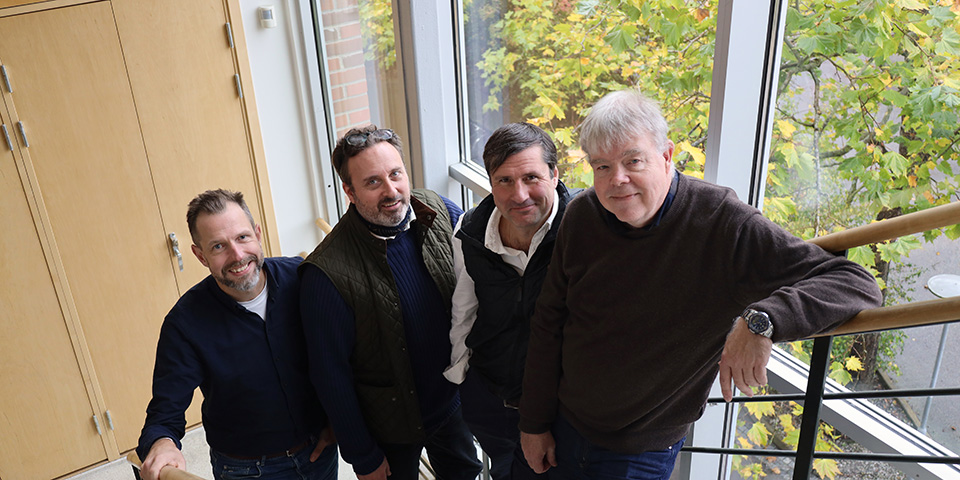
This is the starting point for RESTORE, the Resilient and Sustainable Thermal Energy Conversion Centre, a new research centre led by Lund University in close collaboration with Chalmers University of Technology. Researchers and industry partners will work together to develop knowledge and technology that can accelerate the introduction of electrification, new fuels and thermal energy solutions in industry. This will be achieved without compromising operational reliability, energy supply or competitiveness.
“The transition requires solutions that work under real-world conditions. We need to understand how new fuels and energy solutions can be used in industrial processes without compromising on safety, stability or performance,” says Joakim Bood, professor in the Division of Combustion Physics at the Faculty of Engineering (LTH) and centre director of RESTORE.
A key ambition is to create a coherent chain from basic research to industrial application. The work is based on two closely linked research platforms, one at Lund University and one at Chalmers University of Technology.
Linking cutting-edge research with industrial application
The researchers contribute expertise in areas including energy conversion, combustion and transport processes, safety, modelling and advanced measurement methods. Together, they have access to extensive experimental resources through the laser laboratory at Lund University and the Kraftcentralen facility at Chalmers University of Technology.
“One of the centre’s strengths is that we can link cutting-edge research with industrial application. We can conduct experimental research at all scales, from laboratory to pilot and on to industrial scale. Through collaboration with industry, we can shorten the path from new research findings to technical solutions that make a real difference,” says Klas Andersson, professor at Chalmers University of Technology and deputy centre director for RESTORE.
Close collaboration with industry is key
Close collaboration with industry is a cornerstone of the initiative. The aim is to provide companies with better conditions to reduce their emissions whilst ensuring that production remains stable and competitive. The centre will also help train the next generation of researchers and engineers in sustainable thermal energy conversion.
The researchers are already working in several areas that can lead to concrete reductions in emissions. These include developing hydrogen-powered gas turbines with very low nitrogen oxide emissions, enabling the use of hydrogen in iron and steel industry processes instead of coal, and developing catalytic combustion for hydrogen with reduced pollutant emissions.
RESTORE
RESTORE brings together researchers from Lund University, Chalmers University of Technology, the Swedish Defence Research Agency (FOI) and international partners, including DTU in Denmark, NTNU in Norway, and research centres in Germany, Italy and North America. The initiative is planned to run for up to ten years and will serve as a long-term platform for research and innovation.
RESTORE stands for Resilient and Sustainable Thermal Energy Conversion Centre.
Aim: To develop knowledge and technology for fossil-free, robust and competitive energy use within energy-intensive industry.
Management
- Joakim Bood, Professor, Lund University (Centre Director)
- Klas Andersson, Professor, Chalmers University of Technology (Deputy Centre Director)
- Andreas Ehn, Senior Lecturer, Lund University (Deputy Centre Director)
Participants
Researchers from the Division of Combustion Physics at the Department of Physics, the Department of Energy Sciences, the Division of Fire Engineering and the Department of Aeronautical Sciences at LTH, together with researchers from the Division of Energy Engineering at Chalmers University of Technology.
The centre’s activities are conducted in close collaboration with industry and society, focusing on heavy industry, energy and transport, advanced diagnostics and analysis, and safety and preparedness.
Funding
The Swedish Energy Agency has granted SEK 67 million for RESTORE’s first five years. This funding covers one-third of the centre’s operations. The remaining funding comes from participating academic institutions, research institutes and industry partners through research, education, financial contributions and in-kind contributions. The programme is planned to run for up to ten years.